
Looking to boost your athletic performance with trampoline core work? Try Air Bike Crunches for baseball and tennis rotational power, Jump and Tuck exercises for gymnasts and sprinters, Bounce Down techniques for distance athletes, Agility-Focused Scissors for basketball and soccer footwork, and Surf Twists for water sports and martial arts stability. These exercises reduce joint impact while maximizing sport-specific core engagement. Discover how these targeted movements can transform your game.
Rotational Power: Air Bike Crunches for Baseball and Tennis Players

Athletes who master rotational power gain a significant edge in sports requiring explosive twisting movements.
Air bike crunches on trampolines specifically target your core’s rotational strength, mimicking the mechanics needed in baseball swings and tennis serves.
Master your swing dynamics with trampoline air bike crunches—your secret weapon for explosive rotational power in tennis and baseball.
To perform this exercise, position yourself on the trampoline with a straight back, bent knees, and flat feet. Rotate from your waist, crunching opposite elbow to knee. The trampoline’s unstable surface intensifies core engagement while reducing joint impact.
For baseball players, this builds the stability and power needed during swings and throws. Tennis players will notice improved serve mechanics and faster court coverage.
You can modify the exercise by changing crunch depth or adding wrist weights for progressive overload. Air bike crunches effectively stretch core muscles while simultaneously strengthening them for optimal athletic performance. Incorporate these into pre-season training and maintain throughout the season for peak results.
Explosive Core Control: Jump and Tuck Exercises for Gymnasts and Sprinters
Three essential qualities define elite gymnasts and sprinters: explosive power, precise control, and unwavering core strength.
Jump and tuck exercises on trampolines develop all three simultaneously.
When you perform these exercises, your abdominals activate intensely as you rapidly lift your knees toward your chest. This mimics the explosive movements required in both gymnastics routines and sprint starts.
For gymnasts, these drills enhance the stability needed for tumbling sequences while improving landing mechanics.
Sprinters benefit from increased power output and reaction time vital for acceleration.
Start with 3-5 sets of 10-15 repetitions, focusing on quick, explosive movements.
Keep your body straight and tuck your knees high.
For safety, beginners should use handlebars and gradually increase jump height as proficiency improves.
Endurance Core Training: Bounce Down Technique for Distance Athletes
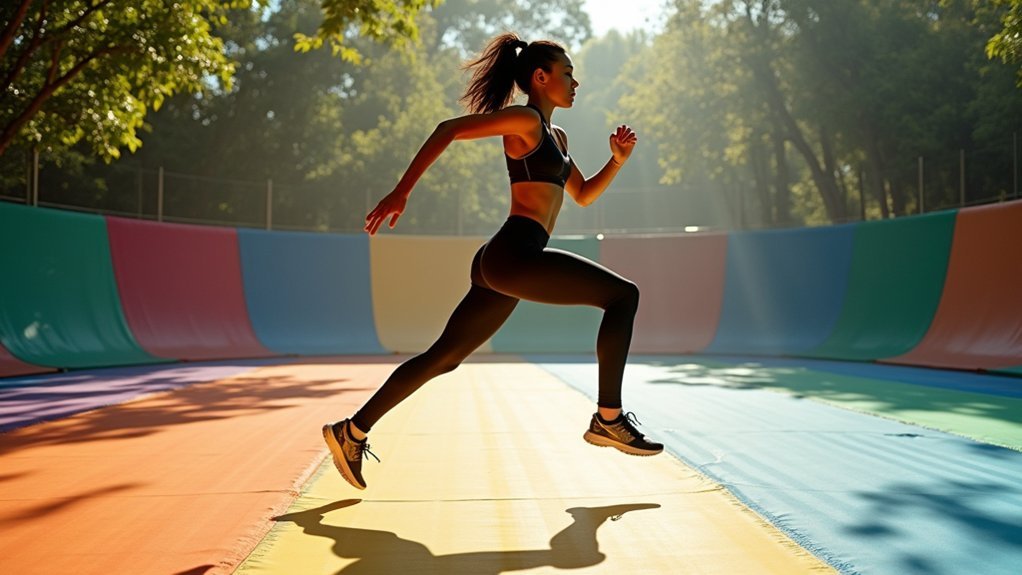
While sprinters and gymnasts focus on explosive power, distance athletes require a different approach to core training on trampolines. The bounce down technique specifically targets endurance by engaging your core muscles through controlled landings.
Practice landing with soft knees while actively engaging your abs and obliques to absorb impact. This low-impact method strengthens stability muscles essential for maintaining proper form during long runs. Following the format of 40 seconds jumping followed by core exercises provides an ideal training structure for endurance athletes.
Try exercises like air bike crunches, twist movements, and side-to-side jumps to develop core endurance. You’ll appreciate how these trampoline workouts efficiently improve cardiovascular fitness while being gentler on joints than traditional training.
Gradually increase intensity by adding repetitions rather than height. For maximum benefit, incorporate controlled landing techniques into each exercise, focusing on core engagement throughout the movement.
These enjoyable, time-efficient workouts will enhance your posture, balance, and overall performance as a distance athlete.
Agility-Focused Scissors for Enhanced Basketball and Soccer Footwork
Scissor movements on trampolines represent one of the most effective agility drills for basketball and soccer players seeking to improve their footwork.
These dynamic exercises target your hip flexors, obliques, and lower abs while strengthening vital ankle and knee stabilizers needed for quick directional changes.
The trampoline’s forgiving surface reduces joint stress while amplifying gravitational load on your core.
You’ll naturally mimic sport-specific patterns like defensive slides and lateral shuffles to evade defenders.
The unstable surface forces constant micro-adjustments, developing proprioception essential for rapid weight transfers during gameplay.
The low-impact nature of trampoline workouts makes scissor movements ideal for athletes recovering from injuries while maintaining conditioning.
To progress, add ankle resistance bands, incorporate medicine ball rotations, or increase tempo to match game speed.
These modifications will reduce your ground contact time, enhance vertical jump height, and improve your dribbling speed through a more stabilized torso.
Surf Twist: Developing Rotational Stability for Water Sports and Martial Arts

The surf twist exercise on trampolines delivers powerful rotational stability benefits essential for water sports enthusiasts and martial artists alike.
Begin standing on the trampoline, twist your torso while keeping shoulders forward, then return to center. After each twist, lift your knees slightly to intensify core engagement and practice balance maintenance. Sync with music for better rhythm and flow during this exercise, which will enhance your overall performance and enjoyment.
Regular practice of surf twists will enhance your rotational power for better surfing maneuvers, kayaking control, and martial arts strikes.
- Engages obliques and core muscles critical for balance and movement control
- Reduces injury risk in high-impact sports by strengthening stabilizing muscles
- Improves power generation for paddling in water sports and strikes in martial arts
- Enhances defensive capabilities through better rotational stability
- Integrates perfectly with other exercises like planks for a complete core workout
Frequently Asked Questions
How Long Should Trampoline Core Workouts Last for Optimal Results?
You’ll get ideal results with 20-30 minute trampoline core workouts. Aim for 3 sessions weekly if doing moderate training, or keep high-intensity workouts to 10-15 minutes daily. Always stop if your form deteriorates.
Can Trampoline Exercises Help Rehabilitate Core-Related Injuries?
Yes, trampoline exercises can effectively rehabilitate core-related injuries. You’ll benefit from their low-impact nature, enhanced muscle activation, improved proprioception, and better balance—all while reducing stress on healing tissues during recovery.
Are Mini-Trampolines as Effective as Full-Sized Ones for Core Training?
Mini-trampolines can be just as effective for core training as full-sized ones. You’ll engage similar core muscles while benefiting from better portability, lower cost, and reduced safety risks with the mini version.
What’s the Ideal Bounce Height for Maximum Core Activation?
You’ll get maximum core activation with a modest 1-2 inch bounce height. Focus on controlled movements rather than height, maintaining an athletic-ready position that engages your core muscles throughout each bounce.
How Often Should Athletes Incorporate Trampoline Training Into Weekly Routines?
You’ll benefit most from incorporating trampoline training 2-3 times weekly into your routine. Allow 48-72 hours for muscle recovery between sessions while gradually increasing intensity based on your sport’s specific demands and your fitness level.
In Summary
Adding trampoline training to your sport-specific routine isn’t just fun—it’s smart training. By incorporating these five exercises, you’ll strengthen your core while mimicking the exact movements your sport demands. Your balance, power, and explosiveness will improve with consistent practice. Whether you’re swinging a bat, sprinting on the track, or maintaining balance on water, your enhanced core stability will elevate your performance.