
Mini equipment offers effective, low-impact options for knee recovery. Start with gentle health bounces, controlled heel digs, and seated leg extensions to rebuild strength. Progress to lateral side steps, knee flexion movements, and modified hamstring curls for stability. Include balance holds, core-knee coordination drills, and controlled marching to improve circulation. Always focus on proper form and gradual progression rather than intensity. These targeted exercises will transform your recovery journey while minimizing reinjury risk.
10 Safe Knee Recovery Exercises on Mini Equipment
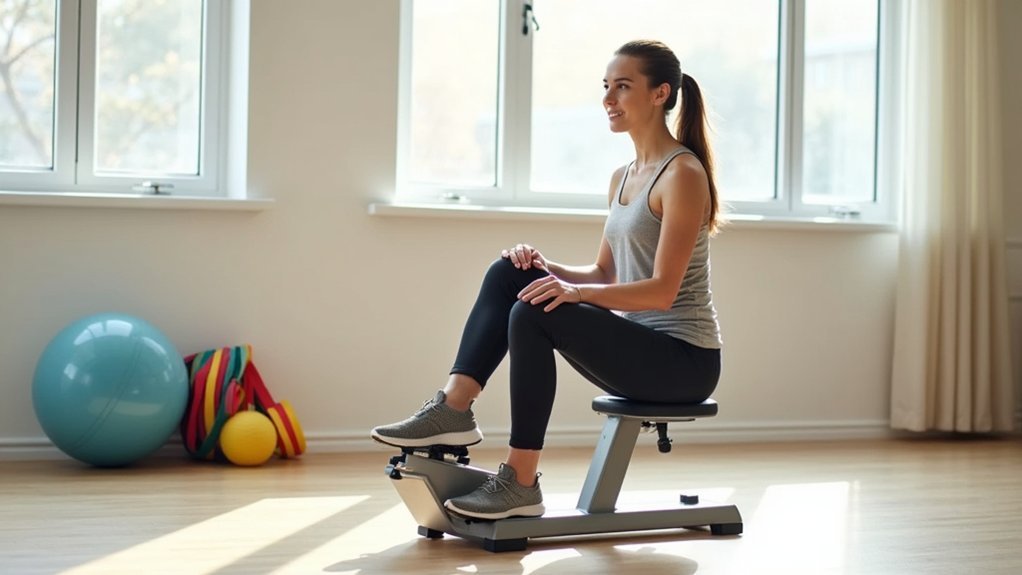
When recovering from knee surgery or injury, using specialized equipment like the MOVAO Mini leg press can greatly accelerate your rehabilitation process.
This compact device is specifically designed for low-impact exercises that strengthen your knee without risking reinjury.
Begin with gentle knee extensions on the MOVAO Mini to restore range of motion while protecting your surgical site.
Starting with gentle extensions on the MOVAO Mini effectively rebuilds range of motion without compromising your healing knee.
You’ll find these safe knee recovery exercises on mini equipment particularly effective for rebuilding quadriceps strength with minimal joint stress.
Try isometric knee presses to engage muscles without excessive flexion, maintaining stability throughout the movement.
As you progress, gradually increase resistance to prepare your knee for daily activities.
This controlled approach helps you rebuild strength and confidence while ensuring your recovery stays on track.
Gentle Health Bounces for Initial Rehabilitation
After knee surgery, gentle health bounces offer an ideal starting point for rehabilitation without straining your healing joint. These low-impact movements promote circulation while reducing stiffness in your knees.
To perform this exercise correctly, keep your toes on the mat while lifting your heels. This technique maintains stable footing and prevents unnecessary stress on your knee joints. Remember to engage your core for enhanced stability and proper knee alignment.
| Day | Activity | Duration | Intensity | Goal |
|---|---|---|---|---|
| 1-3 | Health bounces | 2 minutes | Very low | Circulation |
| 4-7 | Health bounces | 5 minutes | Low | Reduce stiffness |
| 8-14 | Health bounces | 7 minutes | Low-moderate | Build confidence |
| 15-21 | Health bounces | 10 minutes | Moderate | Improve stability |
| 22-30 | Health bounces | 15 minutes | Moderate | Foundation strength |
You’ll build foundational strength before advancing to more intense activities with regular practice.
Controlled Heel Digs to Restore Knee Mobility
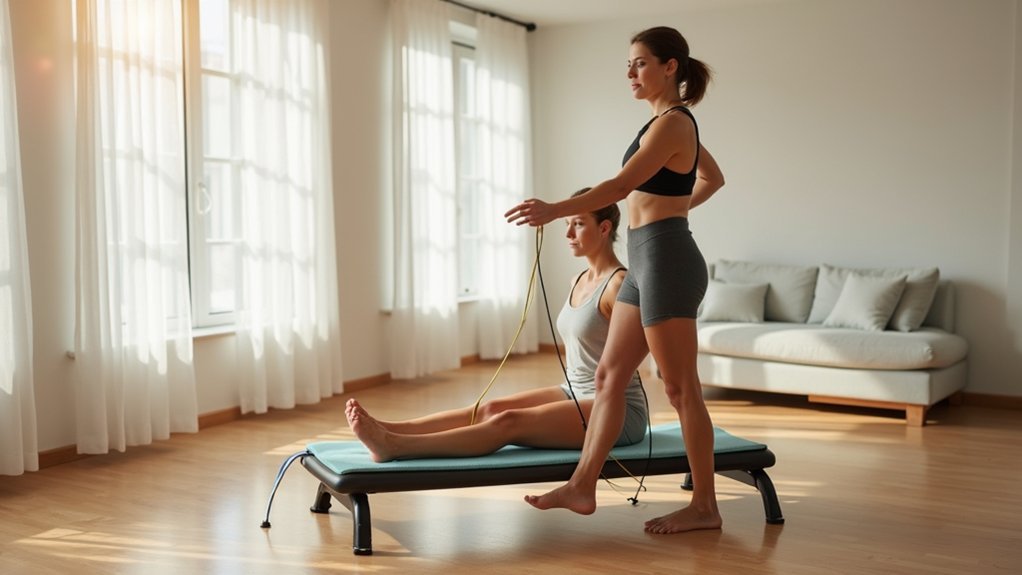
Controlled heel digs offer you a targeted approach to restore knee mobility through their precise heel-to-toe movement pattern.
You’ll start with basic seated heel taps and can progress by adding resistance bands as your strength improves.
When performing this exercise, keep your movements deliberate and focused on maintaining proper alignment between your hips, knees, and ankles to maximize rehabilitation benefits.
Proper Technique Fundamentals
The foundation of effective knee rehabilitation lies in mastering controlled heel digs—a gentle yet powerful exercise that promotes mobility without stressing the joint.
These safe knee recovery exercises require proper form to maximize benefits. Always guarantee your knees track directly over your middle toes during each movement to maintain proper alignment. Engage your core muscles throughout the exercise to provide essential stability for the knee joint.
Begin with deliberate, slow movements, then gradually increase speed as your mobility improves. For best results, perform 10-15 repetitions of heel digs 2-3 times daily. This frequency enhances circulation and gradually builds flexibility in the knee joint.
Remember to keep your toes firmly planted on the ground while alternating heel lifts—this controlled motion is what makes heel digs both effective and gentle on recovering knees.
Progressive Resistance Options
Gradually increasing resistance during heel digs marks the next critical phase in knee rehabilitation.
As you perform this gentle movement—keeping your toes grounded while lifting and lowering your heel—you’ll effectively engage both quadriceps and hamstrings to regain strength and mobility in your knee joint.
Begin with 10-15 repetitions, then progressively extend both duration and frequency as your comfort level improves.
The MOVAO Mini offers customizable resistance settings perfect for heel digs, allowing you to safely advance your rehabilitation journey.
This adjustability guarantees the exercise remains challenging yet manageable as your knee strengthens.
Regular practice of controlled heel digs also enhances blood circulation around the knee area, accelerating post-surgical recovery.
This targeted approach provides stability without overtaxing your healing joint.
Heel-To-Toe Movement Pattern
Mastering the heel-to-toe movement pattern represents a fundamental advancement in knee rehabilitation that builds upon your progressive resistance training.
Through controlled heel digs, you’ll enhance knee mobility while maintaining proper alignment between your knees and toes.
You can perform this exercise seated or standing, alternating heel digs to engage surrounding muscles without putting excessive strain on your knee joint. This movement actively improves proprioception—your body’s ability to sense joint position—creating better awareness during everyday activities.
As you practice the heel-to-toe movement pattern, you’ll notice increased flexibility and range of motion in your knee.
Focus on form rather than repetitions, ensuring your knee tracks directly over your foot. This mindful approach prevents additional stress on your recovering joint while maximizing the rehabilitative benefits.
Mini Seated Leg Extensions for Quadriceps Strengthening
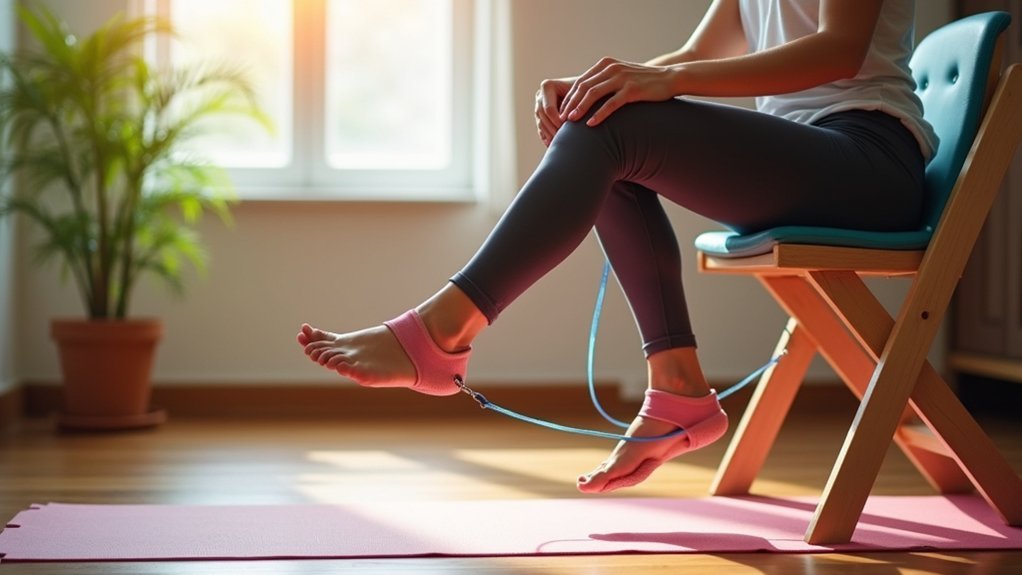
Rebuilding quadriceps strength is essential for successful knee rehabilitation, which is why mini seated leg extensions should become a cornerstone of your recovery routine. This targeted exercise directly engages the quad muscles that support your knee’s stability and function.
Using equipment like the MOVAO Mini provides controlled resistance that’s gentle on healing joints. To perform mini seated leg extensions correctly, sit with your back supported, position your feet on the footplate, and slowly extend your knees forward. Hold briefly at full extension before returning to the starting position.
Start with 2-3 sets of 10 repetitions, focusing on smooth, controlled movements within your pain-free range.
With consistent practice, you’ll notice improved knee function and mobility, accelerating your rehabilitation journey and restoring confidence in your knee’s capabilities.
Low-Impact Side Steps for Lateral Stability
After regaining quadriceps strength, you’ll need to focus on lateral stability to guarantee your knee can handle side-to-side movements safely. Low-impact side steps are ideal for rebuilding the muscles that support your knees during everyday activities.
Keep a slight bend in your knees while performing these exercises, making certain of proper alignment with your toes. Start with short distances and gradually progress as you gain confidence.
| Technique | Benefit |
|---|---|
| Maintain knee bend | Prevents joint strain |
| Proper knee tracking | Makes certain of correct alignment |
| Start with 2-3 feet distance | Builds confidence gradually |
| Add resistance bands | Increases hip abductor strength |
For best results, aim for 10-15 repetitions in each direction. These low-impact side steps won’t just improve stability—they’ll enhance coordination and reduce fall risk during your recovery journey.
Supportive Balance Holds With Core Engagement
Supportive balance holds create a foundation for knee stability by engaging your core muscles to distribute weight evenly and reduce strain on the healing joint.
You’ll find your coordination improves as you practice core-knee connection techniques, such as single-leg stands while activating your abdominal muscles.
As you gain confidence, challenge yourself with progressive stability exercises like holding balance positions while using mini equipment to intensify core engagement without compromising knee safety.
Static Balance Foundation Techniques
While your knee heals, establishing a solid foundation of balance is essential for long-term recovery success.
Begin by practicing static balance positions that engage your core muscles. Stand near a stable surface like a countertop or chair, and gently shift weight onto your healing leg while maintaining contact with your support.
Try holding these positions for 10-30 seconds, gradually increasing duration as you build confidence. Your core engagement is critical—actively tighten abdominal muscles to stabilize your pelvis and spine, creating proper alignment and reducing knee strain.
These exercises activate the small stabilizing muscles surrounding your knee joint, which are fundamental for everyday movements.
Practice standing on one leg while holding onto support, focusing on proprioception—your body’s positional awareness. This foundation work improves stability and greatly reduces your fall risk during recovery.
Core-Knee Coordination Drills
Building upon your static balance foundation, core-knee coordination drills create the critical connection between your trunk stability and knee function.
These exercises enhance your stability and balance, essential components for safe post-surgery recovery.
Practice supportive balance holds by standing on one leg with a slight knee bend, actively engaging your core by drawing your navel toward your spine.
This engagement distributes weight evenly and promotes proper knee tracking during movement.
Try mini squats while holding onto a stable surface to simultaneously activate both core and knee muscles without excessive strain.
Maintain core engagement throughout each movement.
With consistent practice of these core-knee coordination drills, you’ll develop improved functional mobility and reduce your risk of falls—key benefits that support your overall rehabilitation journey after knee surgery.
Progressive Stability Challenges
As you progress through your knee rehabilitation journey, supportive balance holds with core engagement become essential stepping stones toward full recovery.
These exercises strengthen the muscles surrounding your knee joint while improving your proprioception—your body’s ability to sense its position in space.
The MOVAO Mini offers adjustable resistance for these supportive balance holds, allowing you to challenge yourself appropriately based on your recovery stage.
When performing these exercises:
- Activate your core muscles before initiating any balance movement to establish a stable foundation
- Incorporate gentle dynamic movements like leg raises while maintaining your balance to enhance coordination
- Practice consistently to improve functional mobility, which will prepare you for more advanced rehabilitation exercises
Guided Knee Flexion Movements With Resistance
Three critical components make guided knee flexion exercises with resistance essential for post-surgery recovery.
First, these controlled movements allow you to safely increase your knee’s range of motion while strengthening surrounding muscles.
Second, proper resistance levels minimize stress on your healing joint while maximizing circulation to reduce pain and swelling.
Equipment like the MOVAO Mini offers adjustable resistance that’s perfect for your rehabilitation journey.
You’ll want to perform 10-15 repetitions with controlled form, focusing on smooth movements rather than speed. As you progress, gradually increase resistance to continue building strength.
Patients who consistently practice guided knee flexion movements with resistance typically experience better functional outcomes.
You’ll notice improved mobility and decreased discomfort as these exercises help restore your knee’s natural movement patterns and support healing tissues.
Mini Pony Steps for Progressive Joint Conditioning
While many recovery exercises focus on forward and backward movements, mini pony steps target your lateral stability—an often overlooked but essential component of knee rehabilitation.
Perform these gentle side-to-side movements on a mini trampoline or soft surface to minimize impact while maximizing mobility benefits.
To execute mini pony steps effectively:
- Maintain a slight bend in your knees while moving side to side
- Engage your core throughout the exercise to guarantee proper alignment
- Start with 10-15 repetitions per side, gradually increasing duration as you progress
Remember to keep your movements controlled.
The combination of lateral motion and core engagement during mini pony steps strengthens the muscles surrounding your knees while enhancing joint flexibility.
This thorough approach makes mini pony steps particularly valuable for progressive joint conditioning in your rehabilitation journey.
Controlled Marching in Place for Improved Circulation
Controlled marching in place stands out as a fundamental exercise for enhancing blood flow to your recovering knee. This simple movement increases circulation to your lower extremities, which is essential for reducing swelling and promoting healing after surgery.
You can safely perform this exercise on a flat surface or with mini equipment that allows for controlled movements while minimizing joint strain. As you march, maintain proper posture with a slight knee bend and evenly distributed weight.
Start with 2-3 sets lasting 1-2 minutes each, gradually extending your duration as you build strength. This consistent practice not only improves circulation but also strengthens the muscles surrounding your knee, providing better stability and support throughout your recovery journey.
Modified Hamstring Curls for Posterior Knee Support
You’ll find that modified hamstring curls with the MOVAO Mini effectively activate your posterior chain muscles, which are essential for knee stability during recovery.
The controlled resistance of this exercise allows you to gradually rebuild strength while protecting your healing knee joint from excessive strain.
These gentle curls strengthen the muscles that support the back of your knee, creating better balance and reducing pressure on the joint itself.
Posterior Chain Activation
The posterior chain plays a critical role in knee stability during rehabilitation after injury. Modified hamstring curls on the MOVAO Mini effectively target this muscle group while minimizing stress on the healing knee joint.
When performing this exercise, you’ll engage the hamstrings that support proper knee function during your recovery journey.
- Use controlled movements by slowly curling your heel toward your glutes, holding briefly at the top of the motion.
- Perform the exercise from a seated position to reduce joint strain while maximizing muscle engagement.
- Gradually incorporate resistance bands or light weights as your strength improves.
This targeted posterior chain activation helps rebuild strength progressively, improving overall knee function and creating a foundation for successful long-term recovery outcomes.
Controlled Resistance Benefits
Building upon posterior chain activation techniques, applying measured resistance during modified hamstring curls offers significant advantages for knee rehabilitation.
You’ll find that controlled resistance allows you to gradually strengthen the posterior knee muscles without risking additional injury.
As you perform these modified curls, you’re creating a balanced muscle engagement around your knee joint, which is essential for long-term stability.
The adjustable nature of this resistance lets you progress at a safe pace, tailoring the exercise to your current recovery stage.
With consistent practice, you’ll develop greater muscle endurance in your hamstrings—crucial for everyday movements like walking and climbing stairs.
This approach not only improves your knee’s mobility and flexibility but also builds the supportive strength needed to prevent future injuries.
Frequently Asked Questions
Can You Use a Rebounder if You Have Bad Knees?
Yes, you can use a rebounder with bad knees if you maintain proper form, stick to gentle bounces, and consult your doctor first. Wear supportive gear and focus on low-impact movements for safety.
What Gym Equipment Can I Use After Knee Replacement?
After knee replacement, you’ll benefit from stationary bikes, ellipticals, and treadmills for low-impact cardio. Start with light resistance and gradually increase. Don’t forget resistance bands for strength building. Always consult your physical therapist first.
What Is the #1 Mistake That Makes Bad Knees Worse?
The #1 mistake that makes bad knees worse is ignoring pain signals and pushing through discomfort during exercises. You’re causing further damage when you don’t listen to your body’s warnings about knee pain.
What Exercise Equipment Is Easiest on Knees?
The easiest equipment for your knees includes the MOVAO Mini leg press, stationary bikes with low resistance, ellipticals, and water-based exercise equipment. Resistance bands also offer gentle, adjustable resistance that won’t strain your joints.
In Summary
When you’re recovering from a knee injury, mini equipment offers safe options that won’t strain your healing joint. You’ll see faster progress by incorporating these ten exercises into your daily routine. Remember to start slowly, listen to your body, and don’t push through pain. With consistent practice and proper form, you’ll rebuild strength, improve mobility, and return to your normal activities with confidence.


Leave a Reply