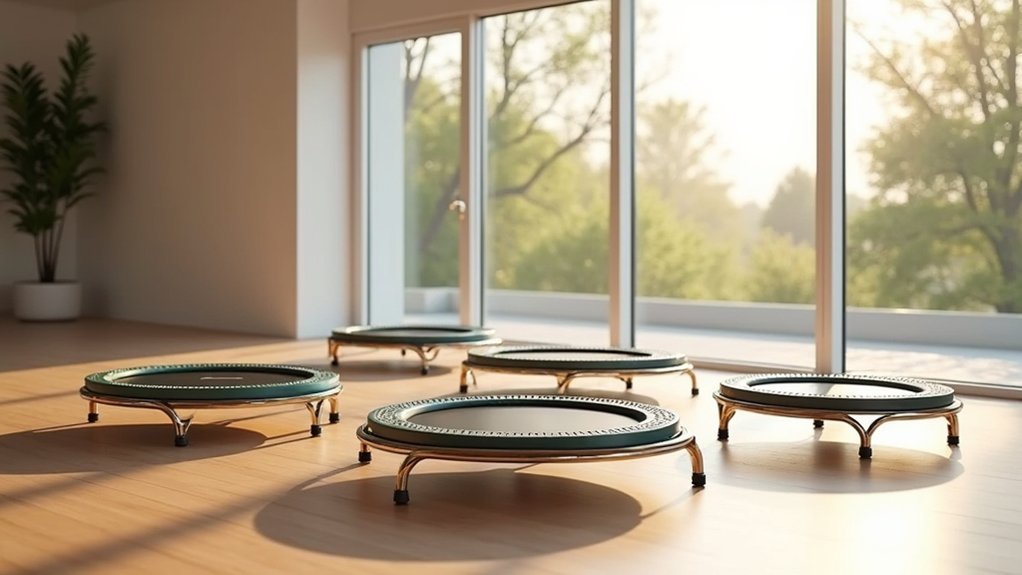
Compact fitness rebounders like BCAN and DARCHEN offer silent bungee systems perfect for apartments, while Fit Bounce Pro provides stability with fixed bungee structures. Look for models supporting 100-150kg with non-slip surfaces and foldable designs for easy storage. You’ll need about 5×5 ft of space compared to 6×6 ft for standard models. The best options balance storage convenience, quiet operation, and durability while providing all the lymphatic and joint benefits of larger units.
Why Compact Rebounders Are Essential for Small Living Spaces
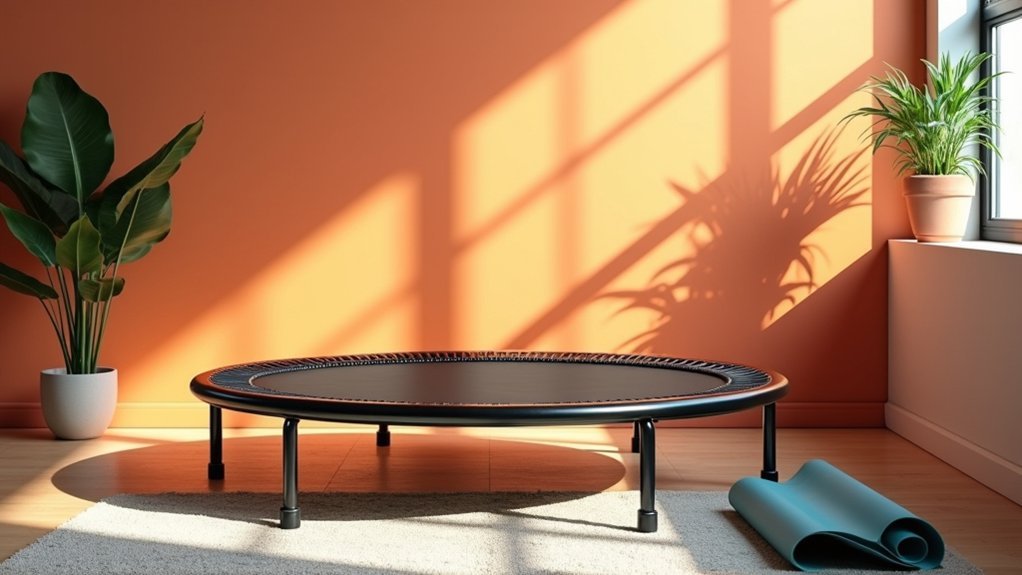
While traditional exercise equipment often demands dedicated space, compact rebounders offer a practical fitness solution for those with limited square footage. You’ll find these mini trampolines particularly valuable in apartments, condos, or small homes where every inch counts.
The beauty of compact rebounders lies in their versatility and minimal footprint. You can easily tuck them under beds, in closets, or behind furniture when not in use, maintaining a clutter-free environment. Many rebounders are designed with foldable designs that further enhance their storage capabilities.
Compact rebounders deliver maximum fitness impact while remaining discreetly hidden away when not in use.
Their lightweight design means you’ll have no trouble moving them between rooms or even taking them outdoors when weather permits.
This space efficiency doesn’t sacrifice effectiveness—you’ll still get a complete workout without dedicating an entire room to exercise equipment, making fitness accessible regardless of your living situation.
Top Features to Look for in Space-Saving Rebounders
Now that you’re convinced of a compact rebounder’s value, selecting one with the right features will maximize both your space and workout quality.
Focus on durability, portability, and performance to guarantee your investment delivers results.
When shopping for your space-saving rebounder, prioritize these key elements:
- Construction quality – Look for robust steel frames, bungee cord springs for quieter bouncing, and non-slip surfaces that can support your weight (typically 100-150kg).
- Storage convenience – Choose foldable models with minimal assembly requirements, ideally including a storage bag and lightweight design for easy transport.
- Performance customization – Seek adjustable tension for varied intensity, stability features like anti-tip legs, and models that support diverse exercise routines. Quality rebounders can burn calories comparable to running at 10-minute mile pace while being gentler on your joints.
The Science Behind Rebounding: Big Benefits From Small Equipment
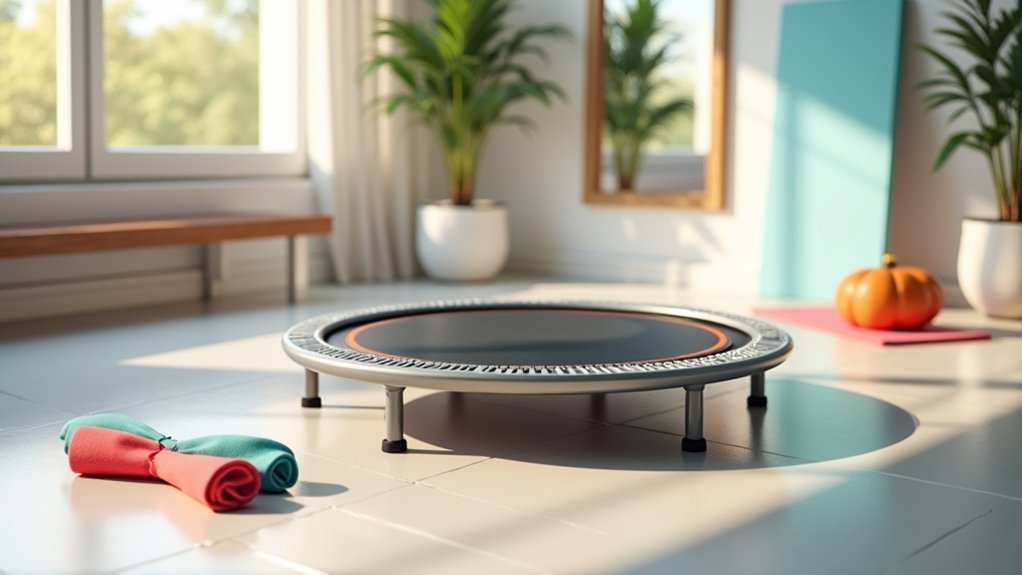
Despite their compact size, rebounders pack a scientific punch that extends far beyond simple cardio exercise. NASA research confirms that bouncing increases G-force, stimulating your lymphatic system and enhancing immune function through improved lymphocyte activity.
Jump your way to better immunity—NASA research proves rebounding stimulates lymphatic flow with every bounce.
You’ll experience joint-friendly conditioning as the elastic surface absorbs impact that would otherwise stress your knees and ankles. This makes rebounding ideal for rehabilitation while still providing cardiovascular benefits. Compared to running on hard surfaces, rebounding offers an 87% reduction in impact shock to joints.
Your neurological system gets a significant boost too, with studies showing improvements in balance, proprioception, and motor performance—particularly beneficial for fall prevention.
The alternating gravitational forces strengthen your bones, engage core muscles, and even strengthen your pelvic floor.
Metabolically, you’ll benefit from increased oxygen efficiency and improved circulation that outperforms traditional treadmill workouts.
Bungee vs. Spring Systems: Which Works Better in Limited Space?
When choosing a rebounder for tight spaces, the battle between bungee and spring systems becomes essential to your success.
Space-conscious shoppers face a clear tradeoff: spring models offer foldability but less stability, while bungee systems provide durability but require permanent floor space.
If you’re dealing with limited square footage, consider these factors:
- Storage needs – Spring rebounders fold down by 50-70%, making them ideal if you can’t dedicate permanent space.
- Noise concerns – Bungee systems operate silently, perfect for apartments with thin walls or downstairs neighbors.
- Safety priorities – Fixed bungee structures eliminate collapse risks and finger pinch hazards, particularly important in multi-use spaces. The Fit Bounce Pro model offers a half-folding design that helps balance storage convenience with structural integrity.
Your space constraints will ultimately determine which system serves you best, with springs winning on pure compactness and bungees excelling in permanently-dedicated workout areas.
Fold-and-Store Models That Disappear When Not in Use

For apartment dwellers and home gym enthusiasts with limited space, fold-and-store rebounders offer the ultimate workout solution that completely disappears after use.
Models like the Costway 40″ can fold into quarters, easily sliding under your bed or into a closet when your workout’s done.
These space-saving trampolines don’t compromise on quality—featuring sturdy steel frames and premium bungee systems that support up to 330 pounds.
You’ll appreciate their versatility for various exercises from cardio to yoga, with many models including adjustable handrails to fit your height.
The cost-effectiveness makes them particularly appealing; instead of gym memberships, you’re investing in a portable fitness station that’s ready whenever you are.
The Stamina 36-inch Folding Trampoline combines rugged all-steel construction with a compact design that makes it ideal for users with space constraints.
Look for models with non-slip foot pads and durable materials designed to withstand frequent folding without losing structural integrity.
Weight Capacity Considerations for Different User Needs
Selecting a rebounder with the appropriate weight capacity guarantees both your safety and the longevity of your equipment. Most compact models support between 100-150kg, but specialized options like the BCAN Foldable Mini Trampoline can accommodate up to 550 lbs for heavier users.
When evaluating weight capacity needs, consider:
- Your physical stats – Choose a model that comfortably exceeds your weight by at least 20 pounds for stability during dynamic movements.
- Activity intensity – Higher-impact workouts require sturdier rebounders with greater weight capacities.
- Construction materials – Bungee cord systems often provide quieter bouncing but may have different weight limitations than spring-based models.
Don’t compromise on weight capacity for portability—adequate support prevents premature wearing and potential safety hazards during your workouts. When shopping for compact fitness trampolines, remember that 39-inch models are typically easier to store and move while still providing sufficient bounce for most exercises.
Noise Levels: Apartment-Friendly Rebounder Options
Living in an apartment shouldn’t mean sacrificing your fitness routine due to noise concerns.
Today’s quiet rebounders use innovative technologies to minimize disturbances to neighbors.
Look for models with bungee cord systems instead of traditional springs—like the Fit Bounce Pro II with its elevated frame that reduces vibration transfer.
The HOMCOM 45″ features thickened bungees and rubber pads that effectively dampen sound, while YORIN’s adjustable handle prevents annoying clanks during workouts.
For sustained quiet performance, regularly check bungee tension and lubricate frame joints.
BCAN and DARCHEN rebounders consistently receive high marks from apartment dwellers for their silent operation during standard jumping sessions.
Remember that foldable designs with pre-assembled components prevent both storage-related creaking and post-setup rattling, keeping your living space—and your neighbors—peaceful.
The Importance of Non-Slip Surfaces in Smaller Rebounders
When it comes to compact fitness rebounders, the non-slip surface isn’t just a premium feature—it’s an essential safety component that can make or break your workout experience.
Smaller rebounders with textured, grippy surfaces prevent dangerous slips during dynamic movements, allowing you to focus on form rather than stability.
Your compact rebounder should offer:
- Enhanced traction – Look for rubberized or water-resistant surfaces that maintain grip even during sweat-heavy sessions.
- Reduced lateral drift – Quality non-slip surfaces keep you centered on the mat, preventing edge missteps.
- Performance optimization – Secure footing enables higher-intensity intervals and better core engagement.
These features aren’t just about safety—they directly impact your workout quality, letting you extend sessions without the fatigue caused by constantly correcting your position. For additional safety and stability during your rebound workouts, you might consider the Adjustable Stability Bar currently available at 33% off.
Handlebar vs. Handle-Free Designs: Pros and Cons
Choosing between a handlebar or handle-free rebounder affects both your stability and available space, with handles providing essential support for beginners but occupying more room.
You’ll find handlebar systems particularly valuable during your learning phase, offering confidence while you master basic bouncing techniques. Though initially helpful, experts recommend gradually transitioning away from handle dependency to achieve maximum muscle activation and stability benefits.
Many compact bungee rebounders now feature innovative detachable handles that integrate directly with the tension system, giving you the flexibility to progress from supported to free-form workouts over time.
Stability vs. Space Efficiency
Deciding between handlebar and handle-free rebounders ultimately comes down to balancing stability against space efficiency.
Handlebar models offer enhanced safety with anti-slip pads and adjustable grips but require 10-20% more floor space than their handle-free counterparts.
When weighing your options, consider these key factors:
- Storage needs – Folding mechanisms can reduce footprint by 50-70%, with compact models like the 66cm Fit Bounce Pro II prioritizing portability.
- Usage environment – Apartment dwellers benefit from smaller 66-99cm handle-free designs with noise-dampening features.
- User requirements – Rehabilitation users typically need handlebars for fall prevention, while advanced athletes prefer unrestricted movement for plyometric training. JumpSport’s innovative patented arched legs provide exceptional stability for handle-free models, making them safer for dynamic exercises without sacrificing space efficiency.
Surface texture and frame materials greatly impact stability regardless of your choice—non-slip mats prevent foot slippage during intense workouts.
Beginner Learning Support
Newcomers to rebounding face a significant learning curve that extends beyond the stability-space tradeoff.
Handlebar designs offer essential advantages for beginners, with enhanced stability during those first wobbly workouts and proper posture alignment through adjustable options like the HOMCOM model.
If you’re recovering from injury or require rehabilitation support, handlebar rebounders provide multi-purpose functionality that handle-free versions can’t match. Some models like the KENSONE 40 Inch Foldable Mini Trampoline are specifically designed with secure handrails that make them ideal for seniors and those needing extra support. However, you’ll pay more for these training wheels.
For those with decent coordination, handle-free models encourage proper technique development from day one. Their minimalist setup reduces assembly frustration, while the lighter weight makes repositioning effortless between exercises.
Many feature anti-slip padding and bungee cord systems that reduce joint impact—perfect for protecting beginners from the common pitfall of training injuries.
Bungee-Specific Handle Integration
While traditional spring designs once dominated the rebounder market, bungee-cord systems have revolutionized how handles integrate with compact fitness rebounders.
These specialized handles offer smoother bounces while reducing joint impact compared to conventional metal springs.
When choosing between handlebar and handle-free designs, consider these key factors:
- Stability vs. Core Engagement – Handles provide balance support for beginners, while handle-free designs force your core muscles to work harder.
- Space & Portability – Handle-free rebounders store more easily and transport better, while bungee-attached handles require careful storage. The Leikefitness Professional 50-Inch model offers excellent stability with its wide-set legs but sacrifices portability since it’s not foldable.
- Exercise Versatility – Handles enable more complex movements and provide confidence for new users, though they typically add to the overall cost.
Your choice ultimately depends on your fitness level, space constraints, and exercise goals.
Setting Up Your Rebounder in Minimal Square Footage
When space is at a premium, finding the perfect spot for your compact fitness rebounder becomes an essential part of your workout strategy.
Choose a location with high visibility to encourage regular use and guarantee safety during your sessions.
Opt for 36-40 inch models, which provide enough surface area for effective workouts while minimizing spatial impact.
Many compact rebounders feature foldable legs, making them ideal for apartments and shared spaces where equipment can’t remain permanently set up.
Always guarantee there’s adequate clearance around your rebounder to prevent injuries from accidental falls.
Position it on a stable surface to avoid unwanted movement during use.
If you’re extremely tight on space, consider models like the Cellerciser that fold completely for storage under beds or in closets between workouts.
For those using rebounders primarily for low-impact workouts or rehabilitation purposes, the 36-40 inch size range provides the perfect balance of stability and space efficiency.
Comparing the Footprint: Standard Rebounders vs. Compact Models
Understanding the footprint difference between standard and compact rebounders can help you make a space-conscious fitness decision.
While standard 44-48 inch models offer greater stability and a generous 18 square feet of bounce zone, compact 39-40 inch alternatives require 30% less floor space while still providing 12.5 square feet of usable surface.
Your spatial requirements will vary based on:
- Room dimensions: Compact models need just 5×5 ft clear space versus 6×6 ft for standard sizes
- Storage options: Both collapse to similar thicknesses (6-12 inches), but smaller models fit under furniture
- Exercise style: Larger surfaces accommodate multidirectional movements, while compact versions work best for basic bouncing
For apartment dwellers under 6’0″, compact rebounders deliver the perfect balance between functionality and space efficiency. Higher-quality compact rebounders can still provide low impact benefits for your joints while taking up less space.
Budget-Friendly Options That Don’t Sacrifice Quality
Quality fitness equipment often comes with a hefty price tag, but compact rebounders break this pattern by offering excellent workout options without breaking the bank.
The Costway Mini Trampoline Set at £45 features padded sides for safety, while the Domyos Cardio Fitness Trampoline costs just £39.99 and includes grippy pads for stability.
Affordable rebounders like Costway and Domyos combine safety features with budget-friendly prices under £50.
For around $70, the DARCHEN Rebounder provides silent performance ideal for apartment dwellers.
Despite their affordability, these models don’t compromise on durability. Many feature metal springs, sturdy frames, and thoughtful details like padded feet to protect your floors. These budget-friendly options can still provide the cardiovascular benefits associated with rebounding exercise.
They’re perfect for beginners or budget-conscious fitness enthusiasts who need versatile workout options.
Remember to check weight limits—the Domyos supports up to 100 kg—to guarantee safe, effective exercise sessions.
Maintenance Tips to Extend Your Compact Rebounder’s Lifespan
Your compact rebounder will last for years with proper maintenance that includes regular cleaning with mild soap and warm water.
Check the bungee tension every 3-6 months, replacing cords that show signs of wear, have lost their elasticity, or when thickness varies between different sections.
When not in use, store your rebounder in a dry place away from direct sunlight, preferably with a protective cover to prevent dust buildup and material degradation.
Proper Cleaning Methods
To maximize your compact rebounder’s lifespan, regular cleaning with the right products is crucial. Use non-caustic wipes or mild soap for routine maintenance, avoiding harsh chemicals that can degrade the mat’s material and damage stitching.
For effective disinfection, Clean Freek cleaner’s non-residue formula works safely on all rebounder components.
After each workout, follow these simple steps:
- Wipe down surfaces with a microfiber cloth dampened with warm water to remove sweat and dirt.
- Blot spills immediately to prevent liquid from penetrating into stitching.
- Allow to air-dry completely before storage to prevent mold or mildew formation.
Keep a dedicated cleaning cloth for your rebounder to avoid cross-contamination, and always guarantee thorough drying before your next bouncing session. Regular inspection of springs or bungees for signs of damage should be part of your maintenance routine.
Check Bungee Tension
Maintaining proper bungee tension serves as the cornerstone of your compact rebounder’s performance and longevity. Inspect cords every 3-6 months for fraying, stretching, or discoloration, and replace them every two years in commercial settings or sooner if damaged.
When bouncing feels uneven or your mat loses responsiveness, it’s time to adjust the tension. Use manufacturer-recommended tools and avoid over-tightening, which stresses mat stitching and frame connections. Confirm tension levels match across all cords for balanced rebounds. Regular lubrication of connection points can also prevent excessive friction and extend cord life.
Seasonal factors matter too—cold weather temporarily reduces elasticity, while humidity accelerates wear. Store your rebounder away from direct sunlight and extreme temperatures.
For reliable performance, rotate cords periodically to distribute wear evenly, and keep spares on hand for quick replacements during routine maintenance checks.
Safe Storage Practices
Proper storage plays an essential role in preserving your compact rebounder’s performance and extending its usable life. When not in use, keep your rebounder in a cool, dry place away from direct sunlight and moisture that can degrade materials and affect spring tension.
For ideal care and protection:
- Use the manufacturer’s carry bag or purchase a protective cover to shield your rebounder from dust and debris.
- If you’re tight on space, choose foldable rebounders that can be tucked away in closets or under beds.
- For basement storage, consider wall-mounted hooks or frames to keep your equipment elevated and prevent moisture damage.
Many rebounders can be easily collapsed and stored behind furniture, like behind couches, to maintain organization while ensuring easy access.
Remember to inspect your rebounder regularly for signs of wear before each use, especially after it’s been in storage for extended periods.
Creating an Effective Workout Routine With Limited Bounce Space
When space comes at a premium in your home gym, compact fitness rebounders offer a perfect solution for maintaining an effective exercise regimen.
You’ll need to adapt your footwork to maximize the 39-44 inch surface area.
Try pulse bouncing with micro-movements to maintain low impact while elevating your heart rate. Single-leg drills optimize intensity without requiring width, while twist jumps engage your core within the confined rebound area.
For variety, incorporate shadow boxing with stationary bouncing for full-body engagement.
Create hybrid routines by alternating 30-second bounce intervals with bodyweight exercises like squats. Consider adding dance elements with choreographed step-touch sequences or combine bouncing with yoga shifts.
Just remember to verify leg locks on collapsible models and allow a 1m perimeter around your rebounder for safety.
Frequently Asked Questions
How Do Rebounders Compare to Traditional Cardio Equipment for Calorie Burning?
Rebounders burn 50% more calories than running at the same intensity. You’ll experience 68% better calorie-burning efficiency, with NASA studies confirming you get superior VO₂ max improvements compared to traditional cardio equipment.
Can Rebounders Be Used Outdoors or Only Indoors?
You can use rebounders both indoors and outdoors. Many models feature weather-resistant designs for outdoor durability, but you’ll need to guarantee they’re properly anchored and regularly maintained to protect from weather damage.
Are Rebounders Safe for People With Back Problems?
Rebounders can be safe for back issues if you choose high-quality models with proper tension, maintain neutral spine alignment, engage your core, and bend knees while landing. Always get medical clearance first for existing back conditions.
How Long Should Beginners Rebound to See Fitness Results?
As a beginner, you’ll see initial fitness results within 2-3 weeks when rebounding for 10-20 minutes, 2-3 times weekly. Gradually increase to 30-minute sessions as your stamina improves for better outcomes.
Can Children Safely Use Adult Fitness Rebounders?
Yes, children over 10 can safely use adult rebounders with proper supervision. You’ll need to guarantee they understand safety instructions, the rebounder has secure pads, and they’re within the weight limits. Always supervise them.
In Summary
Investing in a compact rebounder doesn’t mean compromising on your fitness goals. You’ll get all the cardiovascular and lymphatic benefits while saving precious space in your home. Choose a model that matches your budget, space constraints, and exercise needs—whether it’s a foldable design or bungee system. With proper maintenance and consistent use, your compact rebounder will be a space-efficient fitness companion for years to come.



Leave a Reply