Mini coordination workouts benefit exercise newbies by fitting easily into busy schedules while delivering significant health advantages. These 5-15 minute sessions improve your movement efficiency, cognitive function, and reduce fall risks without overwhelming you. You’ll build confidence through simple movements like jumping jacks before progressing to more complex exercises. The short duration removes intimidation factors while still developing essential neural pathways for better overall movement. The journey to improved coordination starts with just minutes a day.
What Are Mini Coordination Workouts?

While many fitness programs demand significant time commitments, mini coordination workouts offer a practical alternative for beginners. These are short, focused sessions lasting just 5 to 15 minutes, designed specifically to improve movement efficiency by enhancing how your body parts work together.
Mini coordination workouts deliver maximum benefits in minimal time, improving how your body moves without overwhelming your schedule.
For exercise newbies, these mini sessions are perfect because they easily fit into busy schedules without overwhelming you. They’re more than just physical exercise—they boost cognitive function and reduce fall risks while building muscle strength.
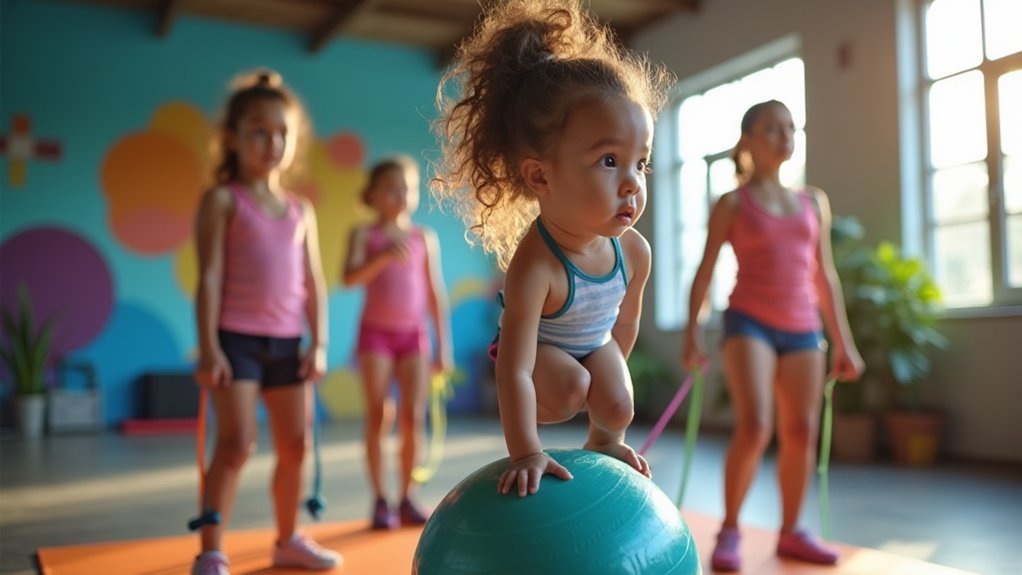
You can try engaging activities like jumping rope, balloon tossing, or walking lunges to make your practice both fun and effective.
The beauty of mini coordination workouts is their accessibility—you can start developing essential skills like balance and hand-eye coordination with minimal time investment but maximum practical benefit.
The Science Behind Short-Duration Exercise Benefits
Although many people believe longer workouts are necessary for fitness gains, research has revealed that mini exercise sessions pack a powerful punch. Studies show that 10-minute workouts can provide similar health benefits to longer sessions, making them ideal for beginners.
The science is compelling: just one minute of sprinting within a 10-minute routine can equal the benefits of 50 minutes of continuous exercise. This efficiency comes from short bursts of high-intensity interval training (HIIT), which greatly enhances cardiovascular health and metabolic function.
Your brain benefits too—brief physical activity improves cognitive function, especially for older adults.
The best part? You don’t need to do it all at once. Three 10-minute sessions throughout your day offer the same advantages as one 30-minute workout, making consistent exercise more achievable.
Building Foundational Movement Skills Without Overwhelm
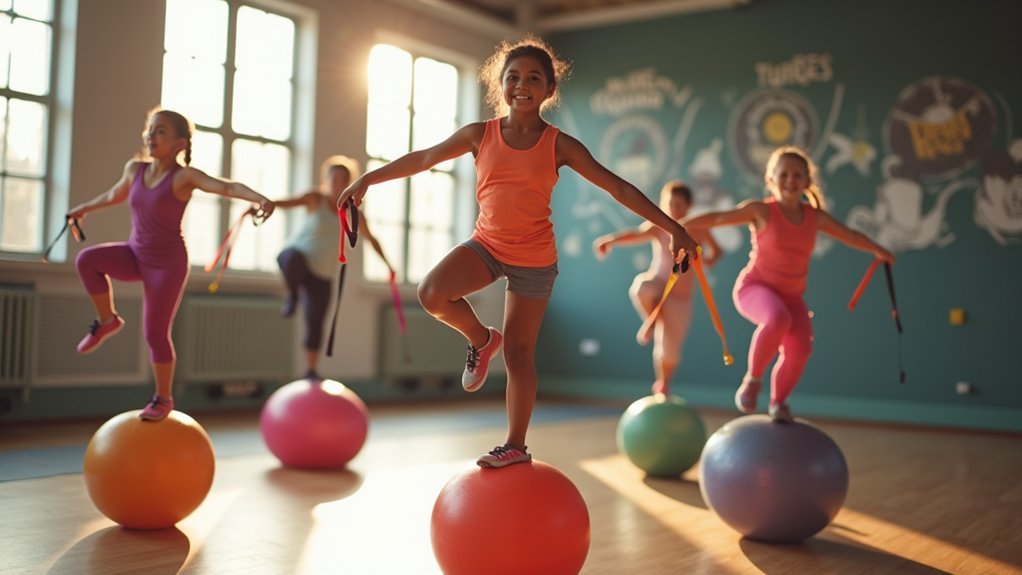
You’ll find greater success in your fitness journey by mastering simple movements first rather than tackling complex routines that can lead to frustration.
These bite-sized coordination exercises build your confidence with each small win, creating a positive feedback loop that keeps you coming back for more.
Starting with just a few minutes of balloon tossing or basic balance exercises removes the intimidation factor while still developing essential neural pathways that support your overall movement quality.
Bite-sized Success Steps
When beginning a fitness journey, many individuals feel intimidated by the prospect of hour-long workouts and complex routines.
Mini workouts throughout the day offer a practical solution, letting you build coordination in manageable chunks of just 5-10 minutes. These short bursts of exercise create foundations for long-term success while boosting your energy levels and cognitive function.
Try incorporating these bite-sized coordination exercises:
- Juggle soft balls for 2 minutes to enhance hand-eye coordination
- Practice 3 minutes of jumping rope for full-body awareness
- Perform single-leg balances for 1 minute per side for better balance
- Try mirror drills with a partner for 5 minutes to improve reaction time
- Complete a 3-minute agility ladder sequence for foot coordination
Confidence Through Simplicity
The journey toward better coordination doesn’t require complex gymnastics or elite sports training. You’ll build confidence through simple physical activities that develop fundamental skills without overwhelming your system. These accessible exercises create a foundation for more advanced movements later.
| Exercise | Benefit | Time Needed |
|---|---|---|
| Balloon toss | Improves hand-eye coordination | 5 minutes |
| Single-leg balance | Enhances stability skills | 3 minutes |
| Slow marching | Develops cross-body coordination | 2 minutes |
When you master these basic movements, your brain forms neural pathways that make all physical activities easier. Research shows these simple exercises boost cognitive function while developing essential movement patterns. By incorporating these mini coordination sessions into your daily habits, you’ll experience noticeable improvements in balance and stability—building confidence with each successful attempt.
How Mini Trampolines Enhance Coordination for Beginners
You’ll build essential coordination skills by mastering simple, consistent bouncing on a mini trampoline before attempting complex movements.
As you practice maintaining your center of gravity while rebounding, your brain creates neural pathways that improve balance and spatial awareness.
The gentle, rhythmic motion challenges your stabilizing muscles to work together, developing the foundation for more advanced coordination-based exercises.
Rebounding Basics Matter
Mini trampolines offer surprising coordination benefits that extend far beyond their playful appearance. When you’re new to exercise, mastering proper rebounding technique creates a foundation for improved coordination and fitness.
- Your body learns to coordinate multiple movements simultaneously, enhancing overall body awareness.
- You’ll develop stronger core muscles, essential for stability in all physical activities.
- The low-impact nature reduces injury risk while you build coordination skills.
- Your cardiovascular system strengthens, contributing to better balance and coordination.
- The rhythmic, enjoyable bouncing keeps you motivated to continue your practice.
Starting with proper form—shoulders relaxed, knees slightly bent, and core engaged—will maximize these coordination benefits.
Even five minutes of daily rebounding practice can greatly improve how your body systems work together.
Balance Through Bounce
Why do mini trampolines work so effectively for coordination beginners? They create a perfect environment where you’re constantly making micro-adjustments to stay centered, engaging your core muscles with every bounce.
This continuous stabilization builds balance naturally while you’re having fun.
The rhythmic bouncing improves your proprioception—your body’s awareness of its position in space—which is fundamental to developing coordination. As you rebound, you’re simultaneously working your arms and legs in synchronized patterns, enhancing your overall body control.
You’ll also enjoy cardiovascular fitness benefits without stressing your joints, making mini trampolines an ideal low-impact option for newbies.
The forgiving surface reduces injury risk while you build confidence in your movements, allowing you to focus on improving coordination rather than worrying about falls or pain.
Starting Small: 5-Minute Rebounding Routines
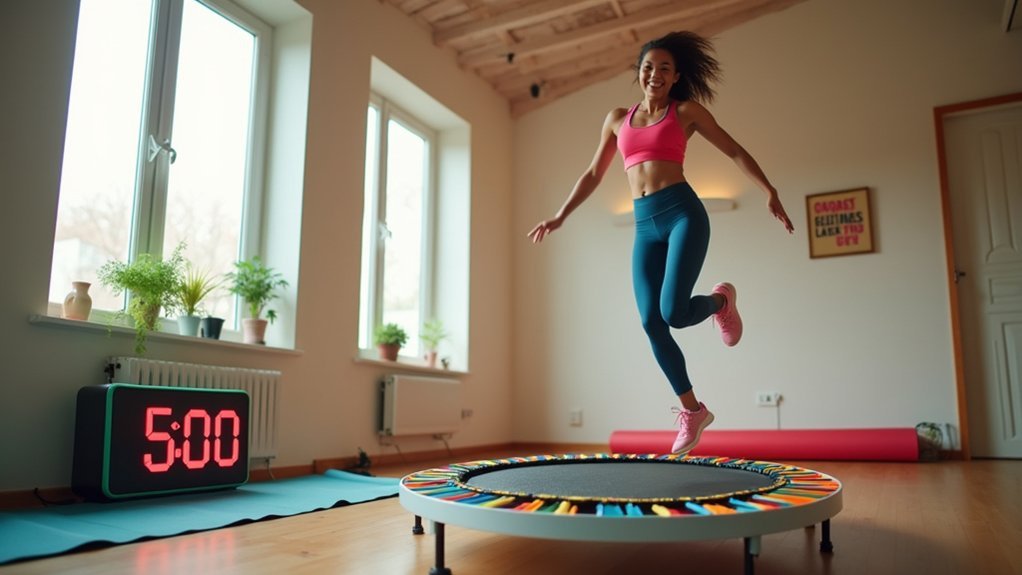
Five minutes is all it takes to begin your coordination journey with rebounding exercises.
These low-impact, short workouts are perfectly designed for beginners who want to build fitness without overwhelming commitments. You’ll quickly discover that rebounding routines offer substantial cardiovascular benefits despite their brief duration.
- Your heart rate elevates rapidly, delivering efficient cardio in just 5 minutes
- The mini-trampoline setup works anywhere in your home or apartment
- You’ll develop better balance and coordination with each bouncing session
- Intensity can be adjusted to match your current fitness level
- These quick sessions build confidence as you establish a consistent exercise habit
Balance and Stability Exercises for First-Time Bouncers
Before diving into rebounding exercises, mastering fundamental balance and stability techniques will greatly improve your bouncing experience. Start with single-leg deadlifts and walking lunges to enhance your coordination and reduce fall risks during your exercise routine.
These stability workouts don’t just build muscle strength—they also sharpen your proprioception, your body’s ability to sense its position in space. You’ll develop greater confidence in your movements while simultaneously boosting cognitive function as your brain processes these coordination challenges.
For beginners, gentle options like Tai Chi or yoga poses create an excellent foundation. When practiced regularly, these exercises improve your cardiovascular efficiency and energy levels.
As your balance improves, you’ll find yourself ready to tackle more complex bouncing movements with remarkably greater control.
Cognitive-Physical Connections in Trampoline Training
Beyond balance exercises, trampoline training offers a remarkable brain-body workout that few other activities can match. When you bounce, your brain coordinates multiple body parts simultaneously, creating powerful cognitive-physical connections that benefit exercise newbies.
- Trampoline workouts enhance hand-eye coordination through continuous balance adjustments.
- The focused concentration required improves cognitive function and memory, especially for older adults.
- Rhythmic bouncing develops spatial awareness and timing that transfers to other activities.
- Elevated endorphin levels from jumping improve both mood and mental clarity.
- Regular trampoline exercise reduces fall risks by strengthening neural pathways that control balance.
These benefits make mini trampoline sessions ideal for beginners seeking to improve their coordination while engaging their minds.
The cognitive demands of trampoline training create lasting improvements that extend beyond physical fitness into everyday movements.
Progressive Mini-Workout Plans for Skill Development
Building coordination skills requires a methodical approach that respects your current ability level while gradually introducing new challenges. A progressive mini-workout routine might begin with simple exercises like jumping jacks before advancing to more complex movements such as juggling or walking lunges.
Develop coordination gradually—start with basic movements before tackling complex skills that challenge your neurological system.
You’ll find that dedicating just 5-10 minutes daily to coordination exercises delivers remarkable benefits. These short sessions help build confidence without the overwhelm of lengthy workouts, making them perfect for beginners.
As you practice consistently, you’ll notice improved overall movement efficiency and reduced injury risk. Even low-intensity coordination training enhances cognitive function, making it easier to learn and remember new movements.
Try incorporating single-leg deadlifts into your progressive mini-workout plan to develop balance and stability—crucial foundations for your continuing skill development journey.
Overcoming Coordination Challenges With Guided Rebounding
You’ll build essential coordination through balance-building bouncing techniques that start with simple two-footed jumps before progressing to alternating leg movements.
Mastering start-stop control on a rebounder strengthens your reflexes and improves your ability to shift between movements smoothly.
These guided rebounding exercises create neural pathways that transfer to everyday activities, making you more coordinated both on and off the mini-trampoline.
Balance-Building Bouncing Techniques
Three simple bouncing exercises can transform your coordination skills without overwhelming your beginner status.
Rebounding offers you a low-impact way to build balance while engaging multiple muscle groups simultaneously. You’ll improve cardiovascular efficiency and boost your mood through increased endorphin production – perfect for exercise newbies feeling intimidated by high-intensity workouts.
- Start with basic two-foot bounces, focusing on maintaining center balance
- Progress to alternating single-leg bounces to challenge your stability
- Add arm movements while bouncing to develop whole-body coordination
- Try catching a soft ball during gentle bounces for hand-eye coordination practice
- Incorporate small directional movements (forward/backward) to strengthen core muscles
These balance-building exercises create a foundation for better movement efficiency and reduced fall risk while building your confidence in a safe, accessible environment.
Start-Stop Control Mastery
While many beginners struggle with quick changes during exercise, mastering start-stop control through guided rebounding provides an effective solution for coordination challenges.
You’ll develop essential skills as you learn to shift between bouncing movements and controlled pauses on the mini-trampoline.
The low-impact nature of rebounding protects your joints while you practice these coordination drills. As you respond to cues to change direction or intensity, you’re simultaneously improving cognitive function and muscle strengthening.
This translates directly to better movement efficiency in daily tasks.
For beginners specifically, these controlled rebounds enhance balance and stability, reducing your risk of falls.
The guided format helps you progress at your own pace, giving you confidence as you develop the coordination that serves as a foundation for more advanced exercises.
Measuring Success in Short Coordination Sessions
Tracking progress in mini coordination workouts doesn’t require complex metrics or sophisticated equipment. As an exercise newbie, you’ll notice improvements in cognitive abilities and balance and stability through simple observations in your daily life.
- You’ll catch falling objects more quickly and efficiently.
- Everyday movements like climbing stairs feel smoother and require less concentration.
- You’re able to maintain challenging positions longer without wobbling.
- Multi-tasking becomes easier as your brain processes movement patterns more efficiently.
- You notice increased muscle strength when performing routine tasks.
These real-world improvements matter more than any numerical measurement. Short sessions create tangible results you’ll feel in everyday activities.
Combining Strength and Coordination on the Mini Trampoline
Mini trampolines offer a perfect platform for beginners to develop both strength and coordination simultaneously. When you perform classic strength exercises like squats or push-ups on this unstable surface, you’ll engage stabilizing muscles that enhance your balance while building power.
| Exercise | Strength Benefit | Coordination Benefit |
|---|---|---|
| Squats | Lower body toning | Balance improvement |
| Push-ups | Upper body strength | Core stabilization |
| Jumping jacks | Full-body engagement | Bilateral coordination |
| Knee lifts | Core strengthening | Rhythm development |
| Plank holds | Total body tension | Proprioception training |
The low-impact nature of mini trampoline workouts protects your joints while challenging your body. You’ll experience cardiovascular benefits as your heart rate rises during dynamic movements, making coordination training efficient even in short sessions. For exercise newbies, this combination offers an all-encompassing workout solution.
The Mental Benefits of Mastering Simple Rebounding Skills
Many exercise beginners focus solely on physical results, overlooking the profound mental benefits that come with mastering simple rebounding skills. When you bounce regularly, you’re actually giving yourself a complete mental health boost while improving your body.
- Coordination exercises on a mini trampoline stimulate brain activity, enhancing your cognitive function and memory retention.
- The rhythmic bouncing naturally elevates your endorphin levels, reducing stress and improving your mood.
- Rebounding promotes mindfulness as you focus on maintaining balance and rhythm.
- You’ll experience growing confidence as you master new skills, fueling your motivation to continue exercising.
- The gentle coordination training considerably reduces anxiety, creating a more positive relationship with physical activity.
Frequently Asked Questions
How Effective Are Mini Workouts?
Mini workouts are highly effective. You’ll gain similar health benefits to longer sessions in just 5-15 minutes. They prevent premature deaths, improve cardiovascular fitness, boost metabolism, and enhance your mood while fitting into busy schedules.
Why Are Coordination Exercises Important?
Coordination exercises improve how your body parts work together, enhancing your movement efficiency and cognitive function. They’ll strengthen your muscles, boost balance, reduce fall risks, and make daily activities easier while improving athletic performance.
Which Type of Exercises Should a Beginner Start With and Why?
You should start with basic exercises like jumping rope, balloon tossing, and walking lunges. These activities will enhance your hand-eye coordination, improve movement efficiency, and build confidence while reducing your risk of injury.
Are 3/10-Minute Workouts Effective?
Yes, three 10-minute workouts are highly effective. You’ll gain the same health benefits as a 30-minute session, improve your cardiovascular health, reduce disease risks, and boost your mood throughout the day when time is limited.
In Summary
You’ll find that mini coordination workouts on a rebounder aren’t just approachable—they’re transformative. By committing just 5 minutes daily, you’re building neural pathways that improve balance, strength, and confidence. Don’t worry about perfect form initially. Your coordination will naturally develop as you progress. Remember, these short sessions aren’t “lesser” workouts—they’re strategic stepping stones toward your larger fitness journey.



Leave a Reply