
Functional core exercises elevate your fitness results by targeting multiple muscles simultaneously in real-world movement patterns. You’ll develop stability, balance, and force transfer capabilities that translate directly to daily activities and athletic performance. Unlike isolated ab exercises, functional core training enhances your body’s kinetic chain, improves proprioception, and prevents injuries through multi-directional resistance. When performed on unstable surfaces like trampolines, these benefits multiply as your body adapts to dynamic challenges. Discover how this approach transforms not just your core, but your entire fitness foundation.
Trampoline Core Stability: The Foundation of Athletic Movement

Stability lies at the heart of every athletic movement, and trampoline training revolutionizes how we develop this essential foundation. When you bounce, your deep core muscles continuously engage through micro-adjustments on the unstable surface, activating your transverse abdominis and obliques with each directional change.
The rhythmic G-forces during rebounds naturally activate your pelvic floor, while demanding precise control that enhances your mind-muscle connection. The integrated strength gained through exercises like the Air Bike directly translates to improved functionality in daily movements.
You’ll experience improved neuromuscular coordination as multiple muscle groups work simultaneously to maintain balance.
This core engagement optimizes your athletic performance by enhancing force transfer between upper and lower body, reducing compensatory movements, and strengthening your kinetic chain synchronization.
The result? More efficient movement patterns, enhanced proprioceptive awareness, and the solid foundation needed for explosive power in any sport.
Rebounding Core Exercises for Enhanced Balance and Force Transfer
Your body’s ability to control momentum during rebounding exercises directly enhances your core’s stabilization capabilities.
You’ll develop more efficient force transfer throughout your kinetic chain as you practice controlling the micro-adjustments required when landing on an unstable surface. Research shows that mini-trampoline workouts significantly improve trunk strength and balance while providing a low-impact alternative that’s gentler on your joints.
Efficient Momentum Mechanics
When athletes master rebounding core exercises, they develop the essential ability to absorb, redirect, and generate force efficiently throughout their kinetic chain.
You’ll see notable improvements in your explosive power as you train with med ball slams that enhance rate of force development—critical for sports requiring rapid acceleration cycles.
Exercises like rotational power drills transfer directly to improved golf swing velocity and tennis serve mechanics. Your body learns to maintain proper ankle-knee-hip-spine alignment during rebounds, maximizing energy transfer without leakage.
Multi-planar movements challenge your core to stabilize while shifting loads dynamically, enhancing neuromuscular coordination. Establishing a strong stabilization foundation first ensures you can safely progress to these more dynamic exercises without risking injury. When you incorporate anti-rotation elements like renegade rows, you’re forcing your core to resist unwanted motion, notably improving force transfer during asymmetrical tasks you’ll encounter in real-world movements.
Stabilizing Through Rebound
The elastic rebound of trampoline-based exercises activates your core in ways traditional exercises simply can’t match. Each bounce engages your deep abdominal muscles through multidirectional movements, forcing constant micro-adjustments that strengthen your transverse abdominis and obliques.
You’ll experience enhanced proprioception as your core muscles contract rhythmically to counteract trampoline oscillations. This low-impact training improves your kinetic chain efficiency while reducing joint stress and preventing energy leakage between movements. This type of exercise tightens the tummy effectively over time, leading to visible core definition with consistent practice.
The unstable surface triggers reflexive stabilization, improving your vestibular system calibration and ankle-hip-core communication. For athletes, this translates to increased vertical jump height, better rotational power, and improved change-of-direction speed.
Plus, the gentle perturbation training accelerates neuromuscular re-education post-injury while strengthening your pelvic floor muscles.
Injury Prevention Benefits of Trampoline-Based Core Training
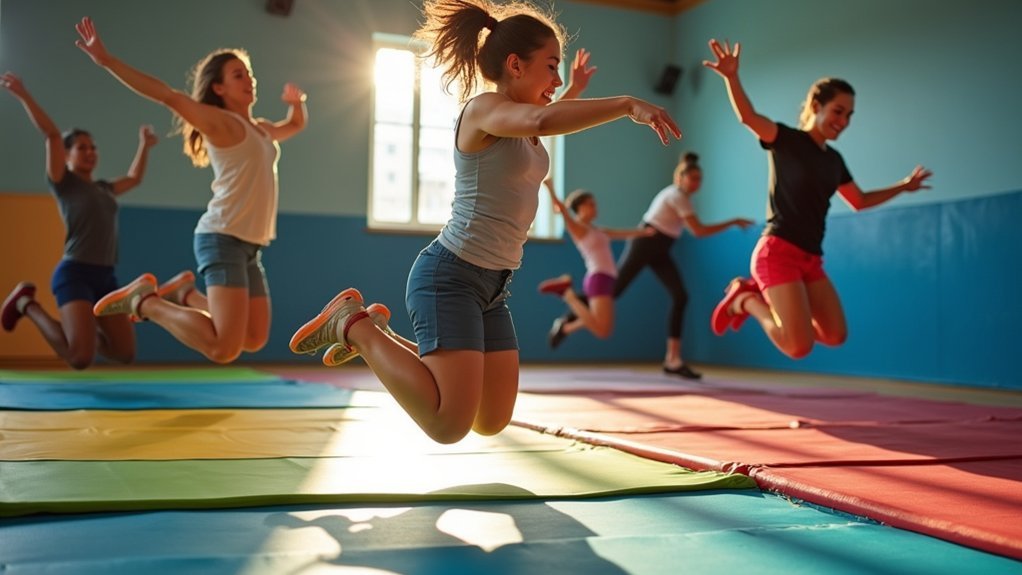
Your trampoline workouts protect your joints with up to 80% less impact than hard-surface exercises while constantly engaging stabilizing muscles throughout your core.
You’ll strengthen the essential balance mechanisms that help you avoid falls and recover from unexpected shifts in daily movement.
The multi-directional nature of trampoline training prepares your body to resist injury from all angles, making it particularly valuable for athletes and those recovering from previous injuries. The trampoline surface effectively absorbs impact, creating a safer environment for intense core-focused routines.
Low-Impact Shock Absorption
Unlike traditional high-impact workouts that strain your joints, trampoline-based core training offers remarkable protective benefits through its natural shock absorption properties. The trampoline surface absorbs up to 80% of impact forces compared to hard floors, dramatically reducing stress on your ankles, knees, and hips.
You’ll experience continuous stabilizer muscle activation as your core engages to maintain balance during dynamic movements. This gentle bouncing stimulates osteogenic activity, strengthening bones without high fracture risk.
The elastic surface decelerates landings gradually, minimizing muscle strain during jumps or twists. The unstable surface also provides valuable proprioceptive challenges, training neuromuscular control without excessive joint torque. For individuals concerned about safety, mini-trampolines or rebounders provide exceptional stability due to their low-to-the-ground design.
This creates an ideal environment for strengthening your body while considerably lowering fall-related injury risks.
Balance Recovery Training
When balance fails during everyday movements, your body’s ability to quickly recover can mean the difference between stability and injury.
Trampoline-based core training enhances this recovery mechanism by engaging deep stabilizer muscles essential for maintaining equilibrium.
You’ll develop improved proprioception—your body’s awareness of its position in space—reducing fall risks and enabling faster reactions to unbalanced positions.
The dynamic nature of trampoline exercises mimics real-life scenarios, training your muscles to respond effectively when stability is challenged.
This training strengthens your core muscles, which act as protective shields for your joints during physical activities.
As you bounce, your body continuously makes micro-adjustments, enhancing coordination and adaptability to unstable surfaces.
The low-impact cardio benefits of trampolining protect your joints while still providing an effective workout that builds balance recovery skills.
The result? A body that’s better equipped to prevent injuries and maintain balance in everyday life.
Multi-Directional Core Activation
Traditional core workouts often focus on single-plane movements, but trampoline-based training revolutionizes this approach through multi-directional activation. Your body constantly makes micro-adjustments on the unstable surface, engaging your transverse abdominis and obliques simultaneously rather than isolating individual muscles. Adult supervision is essential during these exercises to ensure children maintain proper form and prevent accidents while gaining core strength benefits.
When you perform twisting jumps, you’re training rotational stability without external weights, creating functional strength that transfers to real-world movements. The trampoline’s surface absorbs up to 80% of impact forces, protecting your joints while still challenging your core.
- Unilateral bounces activate asymmetrical muscle patterns essential for everyday movement
- Rotational jumps strengthen oblique chains that prevent twisting injuries
- Multi-plane movements improve neuromuscular communication, enhancing reflexive core responses
How Rebounding Transforms Everyday Functional Strength

Though often overlooked as merely a cardiovascular exercise, rebounding on a mini-trampoline delivers profound benefits for functional strength that transfer directly to daily activities.
The low-impact vertical loading mimics stair climbing while developing dynamic stability through unstable surface training.
Unlike traditional exercises, rebounding engages your core in multiple planes simultaneously while gravity-driven resistance activates deep stabilizers like the transverse abdominis. Many seniors find rebounding particularly beneficial because it builds stronger bones while minimizing stress on the body.
Rebounding creates multidirectional core engagement, recruiting essential stabilizers conventional workouts often miss.
You’ll build bone density through gentle osteogenic loading while protecting joints from impact stress.
Your balance improves as rebounding calibrates your vestibular system and trains fatigue-resistant stabilization.
This translates to better posture when lifting and reduced fall risk.
The rhythmic G-force variations also optimize your weight distribution, preparing your body for unpredictable real-world movements you encounter every day.
Correcting Muscle Imbalances Through Bounce-Based Core Work
Core muscle imbalances frequently sabotage your functional movement patterns while remaining invisible until pain or dysfunction appears.
These imbalances—often presenting as overactive hip flexors paired with weak abdominals—create postural deviations like anterior pelvic tilt that can trigger lower back pain and movement inefficiency.
Bounce-based training offers unique advantages for correcting these imbalances:
- Rebound forces create unpredictable perturbations that demand reactive stabilization, forcing your deep core muscles to engage reflexively.
- Multi-planar loading during grounded-to-air shifts challenges your core from all angles, preventing dominance patterns.
- Low-impact activation allows high-frequency core training without compressive spinal loading.
Before strengthening weak muscles, begin with foam rolling tight hip flexors and erector spinae.
Then integrate dynamic stretching with neuromuscular reactivation techniques like dead bugs.
The Science Behind Trampoline Core Training’s Effectiveness
While conventional wisdom often highlights resistance training for core development, emerging research reveals the unique physiological advantages of trampoline-based exercises. Your body experiences enhanced activation of multiple core muscles during dynamic instability, with similar strength gains at lower perceived exertion than traditional methods.
You’ll benefit from the dual impact of cardiovascular improvements (4.4-7.8% VO₂max gains) alongside core conditioning when training at 70-85% HR max. The unstable surface amplifies proprioceptive demands, activating deeper stabilizers through multi-directional movements. Research demonstrates that trampoline training significantly increases isometric trunk extension strength by 26% after intervention, showcasing its effectiveness for back muscle development.
Studies confirm that six-week trampoline programs match gym-based resistance training for functional strength development. Your neuromuscular system adapts through proprioceptive recalibration, improving balance while reducing injury risk compared to high-impact alternatives—all while experiencing the psychological benefits of enjoyable, sustainable exercise.
Progressive Core Rebounding Techniques for All Fitness Levels
Whether you’re a beginner seeking foundational stability or an advanced athlete pursuing peak performance, rebounding offers scalable core training options adaptable to your specific fitness level.
The mini-trampoline creates controlled instability that demands constant micro-adjustments from your transverse abdominis and obliques during both vertical oscillations and rotational movements.
Start with static holds before progressing to dynamic movements:
- Beginners: Master isometric planks and balance positions on the rebounder for 15-second intervals
- Intermediate: Incorporate unilateral movements and Pallof press variations to challenge anti-rotation stability
- Advanced: Combine weighted resistance with multidirectional challenges like twisting pike jumps or rotational medicine ball throws
Progress by manipulating tempo, adding resistance bands, or extending your workout duration from 5-minute intervals to 30-minute sessions. Consistent practice with the right programme for your level, like the bounti Foundation Programme for those recovering from injuries or the more challenging bounti Intermediate for experienced rebounders, ensures optimal results.
Measuring Fitness Results: Tracking Progress in Functional Core Training
Track these key performance indicators at baseline and every 8 weeks to quantify your gains:
| Test Type | What It Measures | Frequency |
|---|---|---|
| Plank Assessment | Endurance & Form | Weekly |
| Single-Leg Balance | Stability Control | Bi-weekly |
| Movement Screening | Functional Integration | Monthly |
| Jump Performance | Power Transfer | 8 Weeks |
| Sport-Specific Skills | Practical Application | 8 Weeks |
Consistent tracking reveals whether your 2-5 weekly core sessions (15-30 minutes each) deliver results. Remember, improvement metrics like improved balance (ES=1.17) and jump performance (ES=0.69-0.84) offer concrete evidence that your core work translates to real-world performance gains.
Frequently Asked Questions
Can Trampoline Exercises Aggravate Existing Back Problems?
Yes, trampoline exercises can worsen existing back problems if you don’t use proper technique or overdo it. However, they’re often beneficial when you start gently and follow appropriate guidelines for your condition.
How Does Rebounding Core Training Compare to Pilates or Yoga?
Rebounding offers more dynamic core activation than Pilates or yoga, providing cardiovascular benefits they lack. You’ll engage stabilizing muscles through multidirectional movement while experiencing lower joint impact and higher calorie burn during your workout.
What’s the Optimal Workout Duration for Trampoline Core Exercises?
For ideal trampoline core workouts, you’ll want 10-15 minutes as a beginner, progressing to 20-30 minutes at intermediate levels. HIIT protocols with 30-second work intervals maximize benefits while preventing form breakdown.
Is Trampoline Core Training Suitable for Pregnant Women?
While trampoline exercises can strengthen your core, they’re generally not recommended during pregnancy due to fall risks. You’ll need your doctor’s approval and should consider safer alternatives for maintaining core strength during this time.
Can Children Safely Perform Functional Core Exercises on Trampolines?
Yes, children can safely perform core exercises on trampolines with proper supervision. You’ll need to guarantee they’re over six, follow safety guidelines, and avoid complex movements. Short intervals work best for their development.
In Summary
You’ve discovered why functional core exercises on a trampoline deliver superior results. By challenging your stability while rebounding, you’re training your body to move as an integrated unit. You’ll notice improved balance, reduced injury risk, and enhanced everyday strength as you progress. Don’t underestimate these bounce-based techniques—they’re backed by science and adaptable to your fitness level. Keep tracking your gains to see the remarkable difference.



Leave a Reply