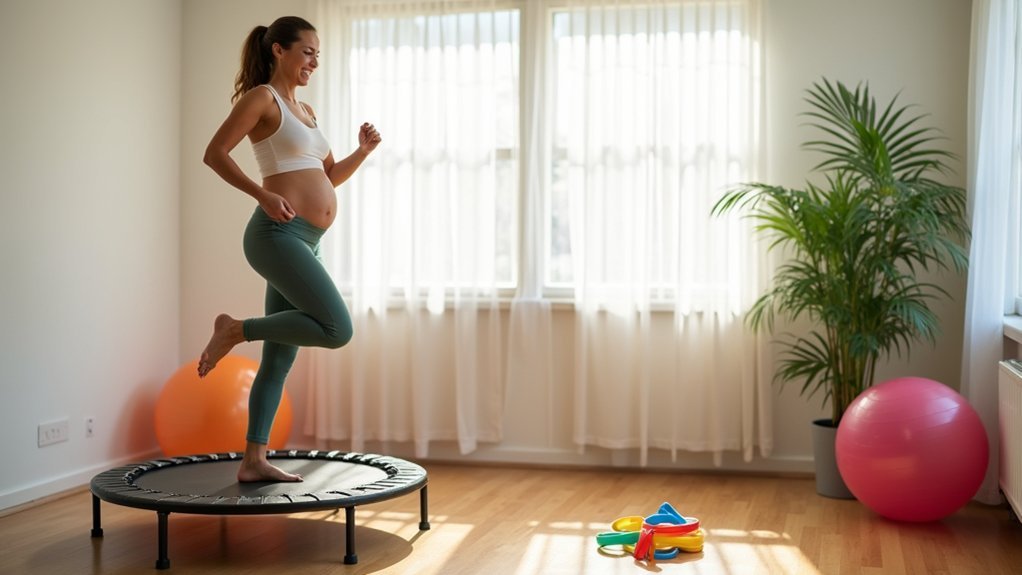
Pregnancy-safe rebounding exercises can strengthen your pelvic floor while providing low-impact cardio. Try gentle marching in your first trimester, pelvic tilt bounces for core stability, and seated rebounding on a stability ball during your second trimester. Add Kegel bounce combinations, wall-supported squats, and modified heel lifts for thorough support. Always finish with pelvic floor cool-down stretches. These seven exercises offer a complete prenatal workout that prepares your body for labor and recovery.
Gentle Marching: Your First Trimester Go-To Exercise

Rebounding during pregnancy doesn’t have to be intimidating, especially in your first trimester when your body is undergoing significant changes.
Gentle marching offers a perfect low-impact option that supports cardiovascular health without straining your joints.
Before starting, consult your healthcare provider and invest in supportive footwear. Focus on maintaining tight abdominals throughout each movement to protect your changing core. Aim for daily sessions at a comfortable pace, always beginning with a warm-up and ending with a cool-down.
Stay hydrated throughout.
This exercise not only improves your mood and flexibility but also prepares you for labor by building endurance and teaching breathing techniques.
For maximum benefit, combine marching with stretching and pelvic floor exercises.
Remember to keep intensity moderate—your heart rate shouldn’t exceed 90% of maximum—and always listen to your body’s signals.
The Pelvic Tilt Bounce: Strengthening Your Core Foundation
The pelvic tilt bounce combines gentle rebounding with deliberate pelvic movements to create a powerful core-strengthening exercise during pregnancy.
You’ll need to adjust your form as your pregnancy progresses, shifting from more active bounces in the first trimester to subtler movements in later stages.
This exercise uniquely engages your deep core muscles while improving pelvic flexibility, preparing your body for the physical demands of childbirth. Regular practice can help alleviate back pain and pelvic discomfort commonly experienced during pregnancy.
Proper Form Fundamentals
To master pregnancy-friendly rebounding exercises, you’ll need to focus first on the pelvic tilt bounce—a fundamental movement that creates a strong foundation for all other techniques.
Maintain neutral spine-pelvis alignment during your bounces, engaging your transverse abdominis and pelvic floor with each movement. This exercise effectively mobilizes the pelvis and lower spine, providing relief from pregnancy-related discomfort. Keep your range small (about 2-3 inches) while synchronizing your breath—exhale during the posterior tilt as you tuck your tailbone under.
For ideal results, position yourself on a firm exercise ball with hips slightly above knees. Incorporate subtle bouncing while maintaining proper pelvic engagement.
Try the wall-assisted technique if you need extra support: lean against a wall with knees bent for controlled tilting.
Practice 10-20 controlled repetitions multiple times daily, gradually increasing hold duration at maximum tilt positions to build strength.
Trimester-Specific Modifications
Now that you’ve mastered proper form, your pregnancy rebounding routine needs specific adjustments as your body changes.
During your first trimester, begin with gentle pelvic tilts on hands and knees to establish core foundation without overextending your spine.
As you enter your second trimester, gradually increase exercise duration to accommodate your shifting center of gravity.
Consider using an exercise ball for modified rebounding that maintains pelvic stability while engaging your core. Incorporating an exercise ball can enhance comfort during pelvic tilts while providing additional support for your changing body.
In your final trimester, focus on slow, deliberate movements in hands-and-knees position to encourage ideal fetal positioning.
Replace high-impact bouncing with gentle movements combined with breathing techniques to prepare for labor.
Throughout all trimesters, maintain neutral pelvic alignment to create space, reduce pressure on ligaments, and alleviate common pregnancy discomforts like low back pain.
Core-Pelvic Connection Benefits
Understanding the core-pelvic connection becomes increasingly essential during pregnancy as hormonal changes dramatically affect your pelvic floor strength.
The Pelvic Tilt Bounce exercise specifically targets this connection, engaging both core and pelvic muscles simultaneously while providing low-impact movement that’s safe for your growing baby.
Regularly practicing this exercise can:
- Reduce your risk of pregnancy-related incontinence, giving you confidence throughout your journey
- Prepare your body for labor with stronger muscles that can aid in a smoother delivery
- Enhance your posture and alignment, easing that persistent lower back pain
- Speed up your postpartum recovery when you need your strength most
Remember to maintain proper technique and moderate intensity as you bounce, always listening to your body’s signals and consulting your healthcare provider with concerns. The coordinated movement helps strengthen the connection between your diaphragm and pelvic floor, as breath mechanics play a crucial role in maintaining proper pelvic floor function during pregnancy.
Seated Rebounding: Safe Second Trimester Options
Sitting on a stability ball while performing gentle bouncing movements offers a safe rebounding option during your second trimester.
You’ll maintain balance and stability while engaging your core muscles with controlled, small movements that support your changing body.
This seated approach eliminates jarring impacts while still providing circulation benefits and pelvic floor support that’s essential during this stage of pregnancy. Always remember to consult healthcare providers before beginning any new exercise routine during pregnancy to ensure it’s appropriate for your specific situation.
Stability Ball Bounce
As your pregnancy progresses into the second trimester, the stability ball bounce offers a gentle yet effective way to maintain fitness while accommodating your changing body.
Choose a 65-75cm ball that keeps your knees slightly lower than your hips to support proper pelvic alignment.
Begin with 10-15 minute sessions on a non-slip surface, positioning your feet shoulder-width apart for stability.
Experiment with mini-bounces, side-to-side rocking, and gentle pelvic circles to enhance mobility without straining. Regular practice of these movements can lead to an uncomplicated birth experience.
- Feel the satisfying engagement of your core muscles with each gentle bounce
- Experience the welcome relief as pressure distributes evenly across your pelvis
- Embrace the calming rhythm that soothes both you and your baby
- Gain confidence knowing you’re preparing your body for labor’s natural movements
Always check with your healthcare provider before starting this exercise.
Controlled Gentle Movements
During the second trimester, seated rebounding offers expecting mothers a safe way to maintain fitness while protecting their changing bodies. Always get medical clearance first, then begin with proper warm-up movements like hip circles and gentle marches while maintaining grip on the handlebar. A proper handlebar is absolutely necessary during pregnancy exercises to prevent potential dizziness or balance issues that commonly occur.
| Movement | Benefits | Safety Tips |
|---|---|---|
| Hip Circles | Lubricates joints | Maintain neutral pelvis |
| Gentle Marches | Activates core | Keep movements small |
| Side Weight Shifts | Engages obliques | Hold handlebar firmly |
| Seated Squats | Strengthens pelvic floor | Use partial range only |
| Heel Slides | Improves circulation | Maintain even weight distribution |
Integrate pelvic floor awareness by engaging Kegels during upward movements and practicing transverse abdominis breathing. Remember to stay hydrated and log any discomfort to adjust your routine accordingly.
Kegel Bounce Combinations: Multitasking for Pelvic Power
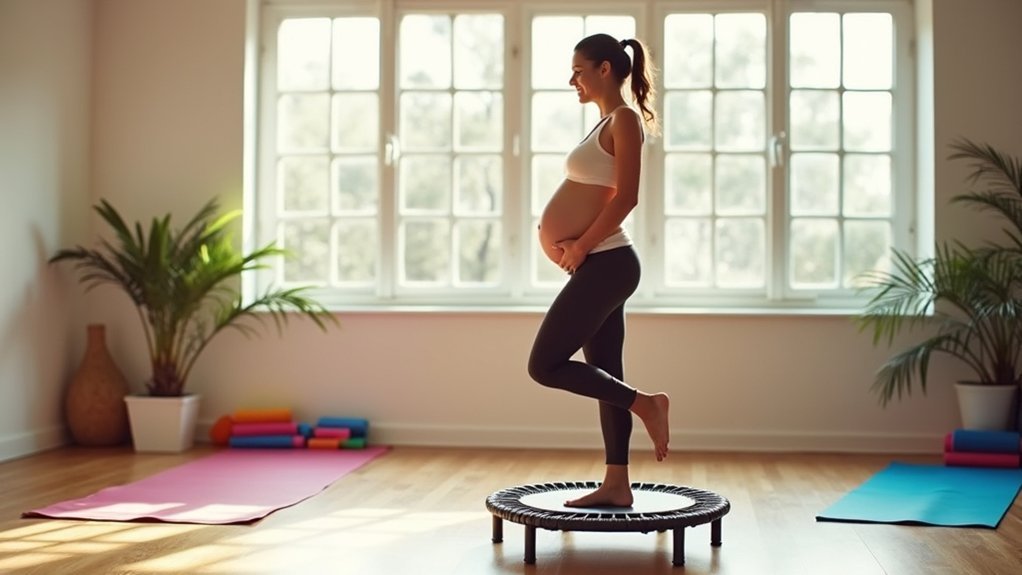
When you combine Kegel exercises with rebounding, you’re creating a powerful synergy that maximizes pelvic floor strength while enjoying cardiovascular benefits.
Time your pelvic contractions with your bounce rhythm—try quick 1-second “flicks” during the airborne phase and longer 5-10 second holds while maintaining gentle bouncing.
- Feel empowered as you strengthen these vital muscles that support your growing baby
- Experience confidence knowing you’re reducing incontinence risk and preparing for easier labor
- Enjoy the satisfaction of multitasking—cardiovascular training and pelvic floor strengthening simultaneously
- Celebrate your body’s resilience as you maintain strength during pregnancy
Remember to exhale during contractions for maximum muscle recruitment.
If leakage occurs, take a break—it’s a sign your pelvic floor needs rest.
Always consult your provider before beginning.
For optimal performance, focus on both the contraction and relaxation phases of each Kegel exercise, as proper muscle function requires the ability to both tighten and release the pelvic floor muscles.
Wall-Supported Squats on Your Rebounder
Wall-supported squats on your rebounder offer exceptional benefits while protecting your changing body. By positioning your rebounder against a stable wall, you’ll gain increased stability while minimizing joint impact—crucial during pregnancy.
To perform effectively, maintain proper alignment with your feet shoulder-width apart and back against the wall. Move slowly, controlling your depth based on comfort. Remember to contract your pelvic floor muscles during each squat and maintain steady breathing. The increased hormone relaxin during pregnancy makes your joints more vulnerable, so avoid deep stretching positions.
As you progress, try variations like sumo squats for targeting adductors or pulse squats for building endurance. Always wear supportive shoes and guarantee your environment is clutter-free.
Before beginning, get medical clearance from your healthcare provider and monitor your breathing and heart rate to prevent overexertion. This exercise simultaneously strengthens your core and pelvic floor—essential for maternal health.
Modified Heel Lifts: Building Lower Body Stability

Modified heel lifts on your rebounder provide essential lower body strengthening while accommodating your pregnancy’s unique demands.
Perform these with slow, controlled movements while maintaining proper posture and knee alignment. Keep your breathing deep and rhythmic as you gently raise your heels. Remember to avoid deep twisting movements during this exercise and focus instead on vertical stability.
Breathe deeply and move with intention, allowing each controlled heel lift to honor your changing body.
For safety, wear supportive shoes and use the rebounder’s handrails if needed. Adjust the depth of your heel lifts based on your comfort level, and always break exercises into manageable intervals.
- Feel empowered as your calf muscles strengthen with each gentle lift
- Experience confidence as your balance steadily improves
- Embrace stability as your core naturally engages during the exercise
- Celebrate progress as your pelvic floor indirectly benefits from this low-impact movement
Cool-Down Stretches for Pelvic Floor Recovery
After strengthening your lower body with modified heel lifts, your rebounder session should conclude with targeted cool-down stretches that nurture your pelvic floor.
Begin with diaphragmatic breathing to reduce tension and enhance muscle relaxation.
Incorporate pelvic tilts to release abdominal tension and gentle clamshells to strengthen external hip rotators while engaging your core.
Don’t forget Kegel exercises—contract your pelvic muscles as if pulling up a string, then fully release them. This contraction-relaxation cycle is essential for effective strengthening.
If you’re newly postpartum, only start when you’re comfortable, and always consult your healthcare provider.
These cool-down techniques improve bladder control, enhance blood flow, and reduce back pain.
A gentle isometric lower abdominal contraction can help reconnect with your core stabilization muscles after childbirth.
Consider dividing exercises into mini-sessions if you need to accommodate comfort levels during your recovery journey.
Frequently Asked Questions
Can Rebounding Help With Postpartum Recovery?
Yes, rebounding helps your postpartum recovery by strengthening core muscles, stabilizing pelvic floor, enhancing lymphatic circulation, and reducing edema—all with minimal joint stress. You’ll get effective exercise in just 10-minute sessions.
How Do I Choose the Right Rebounder for Pregnancy?
Look for a medical-grade rebounder with non-slip surface, adjustable handlebars, and quality shock absorption. You’ll want adequate weight capacity, a frame diameter ≥36 inches, and your doctor’s approval before purchasing.
Can Rebounding Cause Diastasis Recti During Pregnancy?
Yes, rebounding can potentially cause or worsen diastasis recti during pregnancy due to its high-impact nature. You’ll want to consult your healthcare provider before continuing this exercise, especially in later trimesters.
When Should I Stop Rebounding in My Third Trimester?
You should stop rebounding in your third trimester if you experience dizziness, pain, bleeding, or unusual cramping. Most experts recommend discontinuing by 28 weeks or switching to very gentle bouncing with medical approval.
Is Rebounding Safe if I Have Previous Pelvic Floor Issues?
If you have previous pelvic floor issues, rebounding may not be safe without modifications. You should consult a physical therapist first, opt for low-impact options, and stop immediately if you experience any discomfort or symptoms.
In Summary
Remember, you’re nurturing your changing body while preparing for delivery. These rebounding exercises will strengthen your pelvic floor for pregnancy and beyond. Always listen to your body and stop if you feel discomfort. As your pregnancy progresses, you’ll need to modify your routine. Consult your healthcare provider before starting any exercise program, especially during pregnancy. Your pelvic health journey doesn’t end at delivery!